

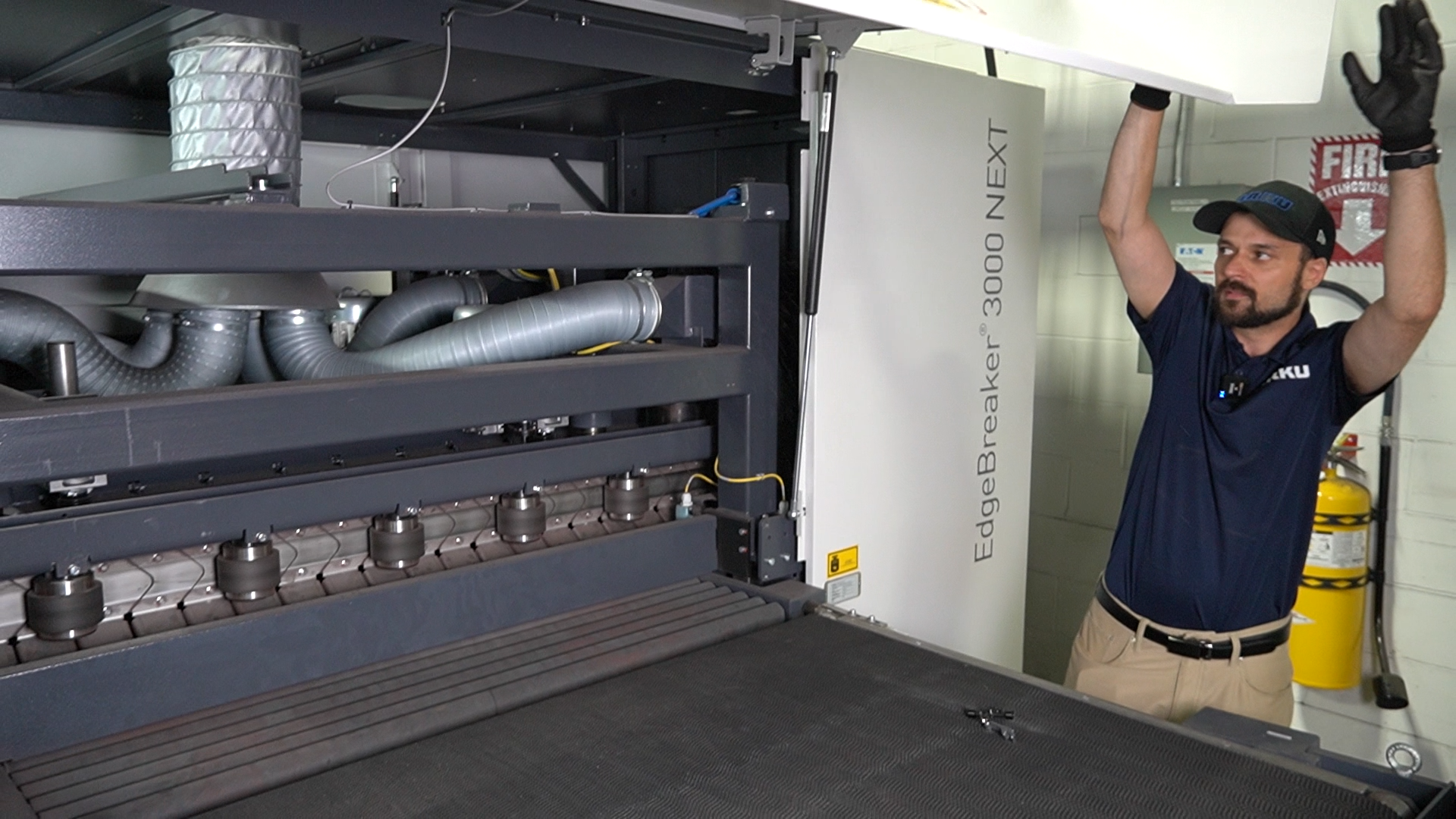
I’ve never encountered a deburring fan club in my travels. If there were such clubs, they would probably comprise deburring machine operators, downstream workers, and customers. Deburring is getting easier and faster to do, and allows the downstream people and customers to use an improved part/blank in their work.
There is always progress in this sector, and the product engineering drives productivity gains. Such is the case with ARKU. You will see a number of engineering improvements in their new model, the EdgeBreaker 3000 NEXT. (A story on the original EdgeBreaker 3000 was one of the first Under the Hood stories done by Fifth Wave and can be seen here: https://fifthwavemfg.com/the-arku-edgebreaker-3000-under-the-hood/.)
Let’s meet the product
The EdgeBreaker 3000 NEXT is an automated deburring machine for double-sided deburring and edge rounding of sheet metal in a single pass. Take note that this product is intended to deburr and edge-round sheet metal that has been cut by a laser or a punch. This is not the product for other types of deburring or slag removal; ARKU offers other solutions for those applications.
The machine comes in three possible configurations, driven by the size of the blanks (or how many you want to gang up at a time). The three models have widths of 51” (1,300 mm), 65” (1,650 mm), and 79” (2,000 mm). Each handles the same variety of thicknesses, from 0.03” (0.8 mm) to 4” (100 mm); if you have thicker material, you have a very good laser or punch.
If you are not used to double-sided processing, you will be surprised to learn that you’ll save more than 50 % of the time involved. How can you save more than 50%? You will save the time for each pass through the machine, as well as the time and effort to remove, flip, and re-insert the parts.
In July 2026, we traveled to Cincinnati to visit our friends at ARKU, Inc., who had just recently installed a 51” EdgeBreaker 3000 NEXT in their facility. Several design features are immediately evident: the load end and the unload end both use a wide belt to carry the blanks/materials; inside the machine, drive rollers do the job. Quick progress checks are done at a glance through the windows located next to the deburring and edge rounding units. Also, if you’ve used an ARKU product, you will note that a newly enhanced display is your control interface to the EdgeBreaker 3000 NEXT.
There are other things too but at this point we should switch over to our well-known operator, narrator, and probably the most-filmed man on our @FifthWaveManufacturing YouTube channel, Denis Weinfurtner, ARKU’s North American Marketing Manager. He is very knowledgeable on ARKU products, what makes them work, and why they work the way they do.
In the first of four videos, Weinfurtner gives us an information-packed but brief overview of the product. Immediately we are taken to the touchscreen which gives control over these aspects of the activity (in this case, we’re doing edge rounding):
- Material thickness
- Feed rate/throughput
- Speed of unit doing the deburring
- Speed of unit doing the edge rounding
- On/off at any time
- Single- or double-sided operation
- Type of abrasive media being used in the machine on each station
- Units used (mm or in.)
Additionally, if you have a number of jobs to do that are repeated fairly often, you can save the settings for these jobs on the control panel and it will save you both time and the aggravation of re-planning repeating work. You can use the control panel with either bare or gloved hands.
One of the important safety features of the EdgeBreaker 3000 NEXT is the warnings or downright “no run” rules that come into play when potentially dangerous or machine-harming settings are entered. Weinfurtner explains these for us in the video; they can save a lot of grief if an inexperienced or ham-fisted operator makes a mistake. Finally, Weinfurtner gives us a couple of good reasons to do edge-rounding in the first place. Let’s get into our subject now:
The redesign of the product includes the core of it, especially the rotating units and the tooling. As Weinfurtner says, most of the changes make it either easier to use or easier to maintain. For example, in older models, you used your hands and arm strength to move the unit around its track. Now, there is a powered solution that makes it much easier to maintain.
One very interesting detail is that the company reversed the tool block seating mechanism. Instead of pushing the block into the unit until it snaps in place, now the operator pulls the block outward from the center. It’s another maintenance and safety feature; if the block becomes dislodged for some reason, it will snap back into place due to the centrifugal force forcing it toward the outside of the unit’s rotation. Simple, but very clever, and as you’ll see, it takes about a second to remove or install a deburring or edge rounding block.
Let’s take a look at these and other redesigned or new additions to the EdgeBreaker 3000 NEXT:
Our third video doesn’t call it out per se, but ARKU notes in its customer literature that the EdgeBreaker 3000 NEXT delivers 40% energy savings compared to its previous generation machine. How can this be? The basis of the claim is this: the company moved from chain drive to direct drive. This is especially notable because the rotating units represent a significant mass. By the time you introduce fittings and chains, you have given away some of the power necessary to move the units. The direct drive takes away those sources of entropy, as well as the chain’s propensity to attract dust and other contaminates.
Weinfurtner discusses the different innovations and the choices you can make when using the EdgeBreaker 3000 NEXT. Let’s have a look:
Our fourth and last video gets us into other innovation areas that probably mean the most to the operator members of the deburring fan club. First, we consider the conveyor system that brings materials through the EdgeBreaker 3000 NEXT. You can have a rubber roller system, or a continuous rubber conveyor belt to transport blanks. The rollers excel at heavier parts, while you can use the conveyor to move blanks that are light to medium in weight. In the lighter and thinner materials, the conveyor makes it impossible for something to accidentally get in between rollers. (The interior of this machine always uses rollers.)
Second, we get a look at how the delivery side of the machine has an automatic on/off switch if one of the blanks goes all the way to the end of the conveyor. Weinfurtner’s demonstration shows how it works and it is simplicity itself. It takes away a potentially dangerous and destructive happenstance of a blank going all the way off the end because some distraction or mistiming.
The third innovation has the operator in mind too. To meet cleaning, maintenance, and changeover needs, ARKU has designed a new access door—on both the entry side and the exit side—that is big enough to allow access to just about anything inside. In fact, it’s positioned just right for the operator to change the maximum number of deburring or edge rounding blocks at a time (in case your shop processes different materials).
Things to consider
ARKU makes no claim that a machine like this is a must for every shop. However, if you think about the offering, you can make a list of earmarks for potential process improvements:
- Downstream processes that get delayed because of flaws
- Downstream processes that are expensive
- Deburring and edge rounding processes that are addressed with hand tools
- Painting, powder coating, and chemical coating that perform well on smooth surfaces but chip on flaws and corners
- Fittings that don’t fit
Additionally, as robotic and laser welding take a bigger market share, more accuracy and precision is demanded across the neighboring processes. There is much money to be saved by streamlining welding with a new computer-controlled process.
Finally, ARKU is trying to keep up with demand. The company expanded its Cincinnati location and opened a new location in Greer, SC. Contract leveling is a key service at these spots, but customers are welcome to bring or send their challenging deburring/edge rounding project samples to ARKU for evaluation.
More information: https://www.arku.com/en-us/deburring-machines/laser-cut-and-punched-parts/edgebreaker-3000