

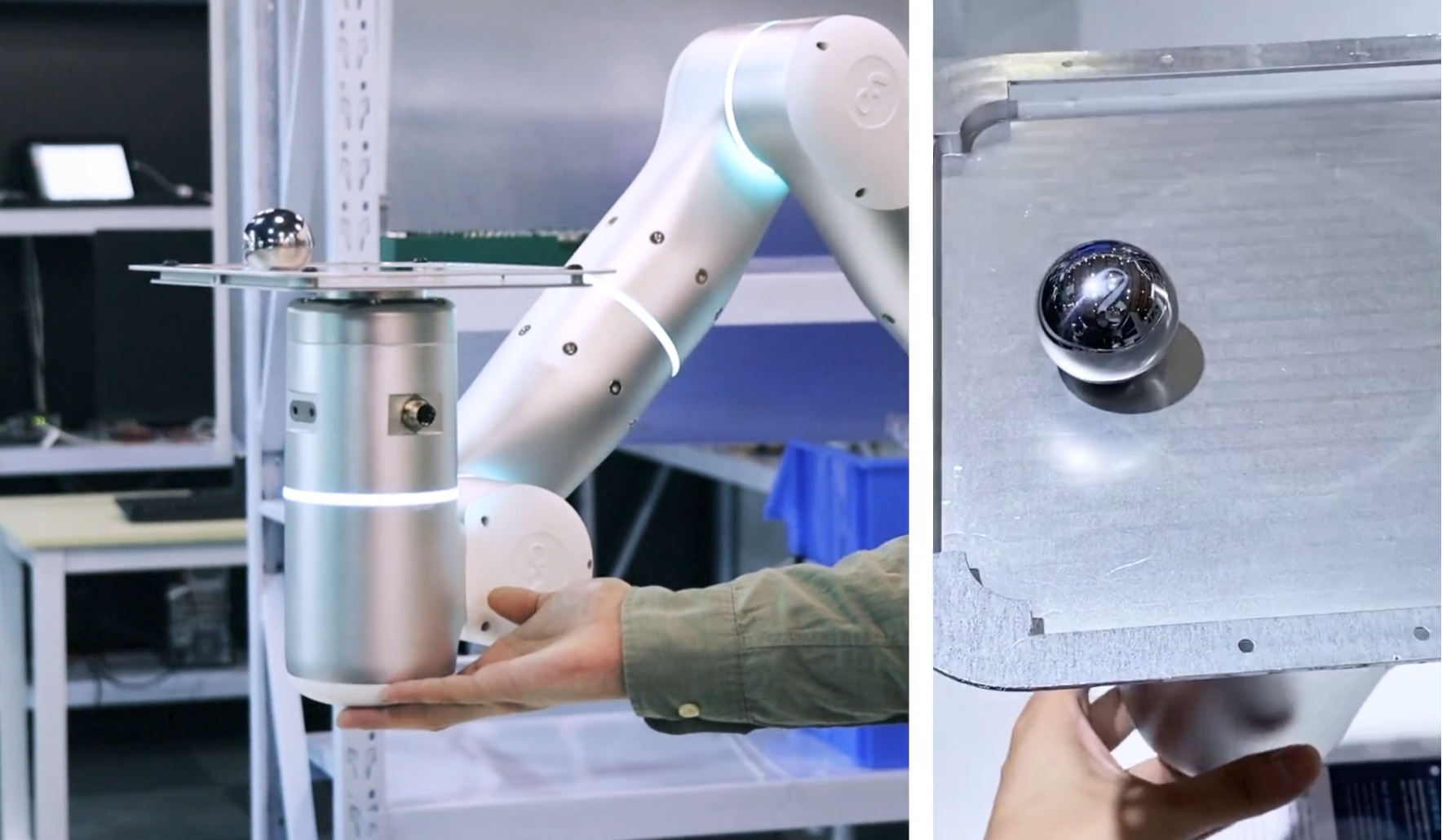
Robot maker Flexiv (Santa Clara, CA) announced that its flagship Rizon 4 adaptive robot is now supported in the NVIDIA Isaac development platform. This support includes a new contact-rich insertion reference workflow from NVIDIA built on NVIDIA Isaac Lab, Isaac ROS, and Rizon 4.
By integrating the Rizon 4 with NVIDIA’s software stack, roboticists gain native access to hardware-accelerated packages optimized for NVIDIA GPUs. This support significantly reduces the computational overhead of AI, motion planning, and real-time environment processing, allowing teams to focus on high-level application logic.
NVIDIA’s new contact-rich insertion reference workflow enables a reinforcement learning policy trained in simulation and transferred to real hardware. The first instance of the workflow is DisplayPort cable insertion, running on a Rizon 4 series arm with a Flexiv Grav gripper:
- Train in simulation. The insertion policy is trained at scale in NVIDIA Isaac Lab using the Newton physics engine, with randomization over socket pose, contact properties, and robot dynamics so the policy learns to succeed without being told exactly where the socket is.
- Deploy through Isaac ROS. The trained policy runs on the physical robot through GPU-accelerated Isaac ROS packages, alongside FoundationPose for pose estimation and cuMotion for motion planning for the approach phase.
- Close the loop on contact. The Rizon 4’s task-space high-performance force control framework provides the compliant, contact-aware, dynamically precise execution the policy depends on during the final millimeters of insertion.
The workflow and its simulation assets are being released so developers can reproduce the DisplayPort reference workflow and adapt the same recipe to their own connectors, sockets, and fixtures.
Force-sensitive applications such as assembly, insertion, and polishing have long fallen between two worlds: research platforms that are open but not production-ready, and industrial arms that are robust but closed. The Rizon 4 bridges that gap, which is what made it a fit for this workflow:
- Permissive SDK. Low-level control, including streaming motion commands at 1,000 Hz — a rare capability among industrial robots, and a prerequisite for running a learned policy at high rate on real hardware.
- Integrated sensing. Built-in joint torque and force-torque sensors eliminate the need for external sensing hardware.
- A well-tuned high-fidelity force controller. Predictable, well-characterized low-level control makes it substantially easier to transfer a simulation-trained policy onto the physical robot.
Those same properties are already being used in production settings: electronics manufacturers apply the Rizon platform’s force capabilities to tasks such as high-precision, contact-rich assembly, while physical AI developers build on the open SDK and integrated sensing for similar workflows.
Unlike traditional position-controlled robots that rely on rigid, pre-programmed trajectories, the Rizon 4 can sense and adjust to contact forces in real time. This enables it to compensate for variability in object position, surface properties, and material compliance, making it ideal for tasks that use AI-driven perception to make intelligent decisions about how to act.
More information: Full platform documentation and hardware support packages are available on the NVIDIA Isaac ROS Flexiv page: https://nvidia-isaac-ros.github.io/robots/flexiv/index.html