

Automation is the major trend in fabrication, and has been for a few years now. Today, automation includes everything from robotics to cameras and machine vision, from loading/unloading materials to picking and sorting parts, from safety to remote control. There are even more examples of automation, and we’ll explore them shortly.
The TRUMPF TruLaser Center 7030 was born of the drive toward automation. Ten years in the making, it debuted at the 2016 Euroblech event in Hanover, Germany. Later, production started, and customers began integrating these cutting systems into their workplaces. Since then, the automation technologies have matured, and additional capabilities have come on line to this platform.
The basics of it
There are a few ways to answer challenges in laser cutting, or any fabricating function, for that matter. You can add capabilities that overcome the problem, you can manage and mitigate from a prevention point of view, and you can design problems out of the equation. It seems that TRUMPF has taken the third path, they have designed some of the problems out. Some of the key opportunities in using a blank slate with a new approach to design are:
- Less human handling/interaction during the entire process is better, none is best;
- Automated part picking and sorting immediately after each small part is cut;
- Automated part picking, movement, and sorting after each larger part is cut;
- No tipping;
- No micro or nano joints;
- Supply itself with material, store and move the parts itself; and
- Take care of the dull, dirty, dangerous jobs in cutting.
The last point is important because safety is a factor when we speak of cutting, picking, and sorting parts. It also contains the “3Ds” of the robot community; these are the jobs where robots (and cobots) excel. While that is true, there is not a robot to be found on this gentle giant of a laser center. Automation abounds, however, answering those three challenges and many more by putting the automation right where it is needed in this complex system.
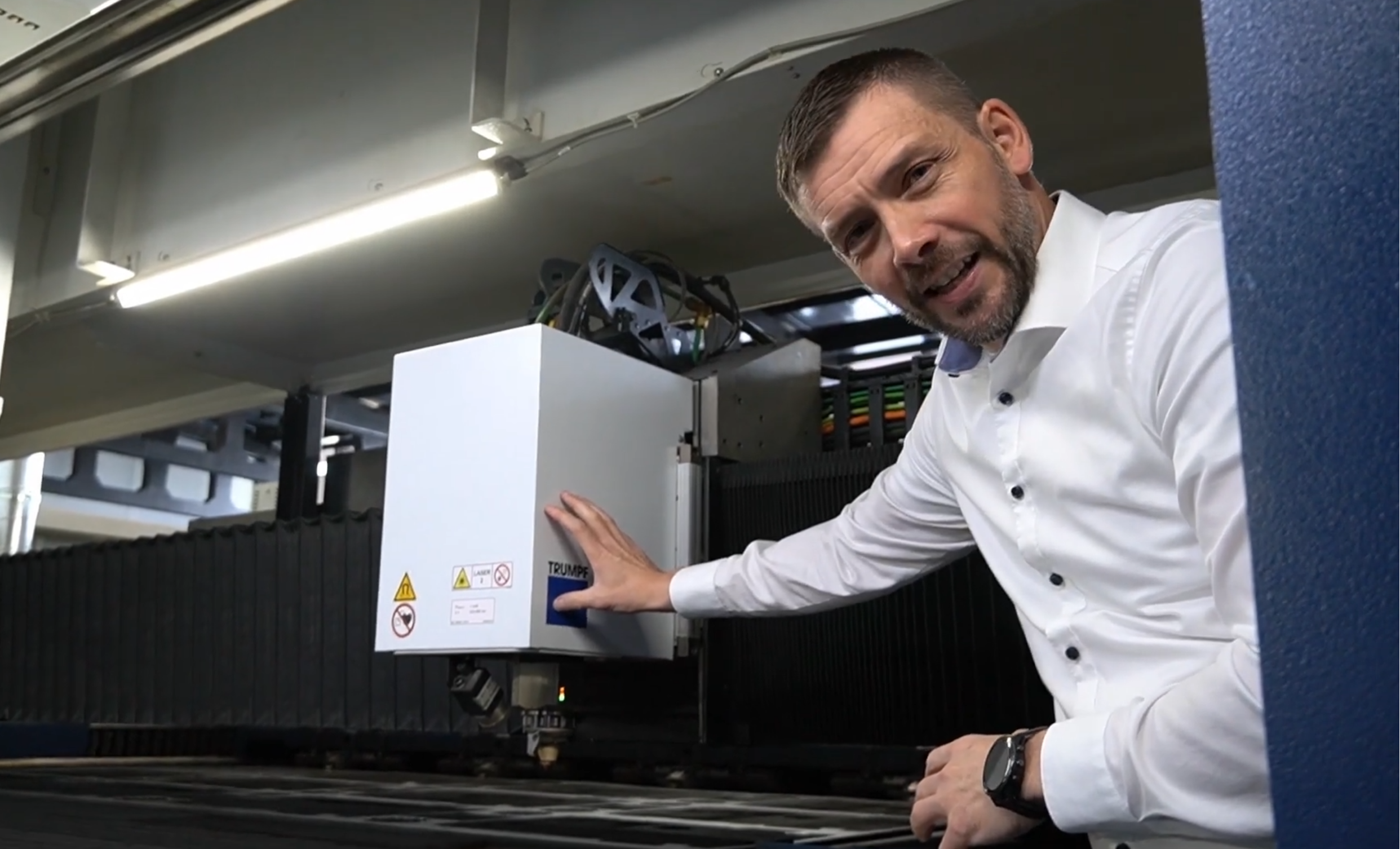
Our host and video star for this Under the Hood episode is Andreas Bunz, Head of Robotics for TRUMPF, Inc. He is based at TRUMPF’s Smart Factory in Hoffman Estates, IL, just outside of Chicago. (If he seems familiar, we interviewed him in mid-2025: https://www.youtube.com/watch?v=65JYjMQ-DC0.)
In addition to his post as head of robotics, he also manages the TruLaser Center 7030, and you will find that no question is discarded or left unanswered.
Bunz gives us a thorough overview of the system. One of the first topics is the skeleton, and the total lack of parts in it after cutting. Every part is always removed, and the system tracks them all. Part removal and sorting are programmed into each job. The TruLaser Center 7030 also has no slats, meaning there is no need for micro or nano joints, and of course no need for someone to disconnect those thin links manually.
Instead of slats, a vast brush table is the surface of choice, which makes the sheet easily movable while protecting the surface. Additionally, all cutting happens in a very specific area, compared to most laser cutters. The cutting unit moves across an x axis, with additional motion coming from the (clamped-down) sheet as well as the cutting head, which can move a small distance in the y axis. Imagine the complexity and the possibilities of motion coming from three sources and you’ll have an idea about the speed and limitless shapes produced by this machine.
Let’s get the introduction essentials from Bunz:
Our second video is a significant follow-on to the introduction, and in fact puts action to the topics discussed by Bunz in the first video. We start with the small and work our way up to the large.
We go immediately into cutting. Small cut waste drops through the SmartGate into a waste bin. Small parts are collected similarly; the two halves of the SmartGate open to accommodate the part, with the width of the opening set in the program. Helping the part through is the ejection cylinder, which descends in the z axis to push a part through the SmartGate. It happens very quickly, but keep your eyes ready to see it in action at about 1:43 in this second video.
Once the parts drop, they are transported to the correct bin underneath. The bin can be pulled out from underneath the laser like a train hooked to a pallet jack-type lead.
Larger parts are removed by the SortMaster Speed, and stacked on a pallet at the far left (as you face the access doors) inside the machine. As the SortMaster Speed descends onto the large part, a set of pins called SmartLift emerges upward in the z axis to meet the bottom of the part and hold it against the SortMaster Speed as the suction cups grip. The pins rise from between the rows of the brushes on the brush table to push up on the bottom of the part; they are programmed at the time the parts are programmed.
Bunz gives us more details on all this technology, as we watch it happen in this second video:
When you hear about a fully automated machine like this, you begin to ask questions like, “What if I want to pull a part and check it like I would on a normal machine?” The answer is you still can, although you won’t be the one fetching it—SortMaster Speed will bring it to you at the inspection access door.
Your job is to ask for it on the operator console. Onscreen you choose Test Part, which amounts to a part being submitted for a visual quality inspection. Once this command is entered, the shuttles of the SortMaster Speed bring a part to you. You pause the machine, open the access door, and there is your part attached to the suction cups so that you can get a good look at the surface of the part. If everything seems OK, including the attachment to the suction cups, you close the door and confirm on the operator console that the part should continue along with the other parts (in this case, to be stacked on a pallet). If you detect a problem, the system can and will put the part aside for you.
Here is how this process looks in real life:
It will be good to investigate the SortMaster Speed further since it has important jobs to do, including move material, skeletons, parts, waste parts, and serve the need for inspection.
As you would expect, with 2,772 suction cups to manage—that’s 462 suction cups on each of six shuttles—it needs to be an organized approach. Each suction cup’s place is determined by letter and number, G12, for example. Each shuttle has two teammates. Two groups of three serve the operator and the programming. Each group of three shuttles is attached to a stout track arm system to create SMS 1 and SMS 2 (the SMS stands for SortMaster Speed). SMS 1 and SMS 2 have the run of the place. They can be positioned in close proximity or many feet away (for example, if they are transporting a heavy skeleton).
Bunz gives us a close-up view of the bottom of one of the shuttles. We can see the suction cups clearly, but what are the pointed pins sticking out of the bottom of the shuttle? These spring-loaded pins detect the state of the part. Is the part in contact with the shuttle? Is it lifted by the SmartLift pins so the part is flush against the suction cups? The questions are answered by the presence or absence of electrical resistance, much like a circuit continuity tester. This gives the system a yea or nay to continue its mission.
The system will also know whether the part is successfully cut. If it is, has it been successfully lifted? The second test becomes very important as the thickness of the material and the weight of the part increases.
Bunz points out in the video that one of the strengths of having the two sets of shuttles is the ability to make use of simultaneity. When SMS1 (the three-shuttle assembly nearest the operator) is moving a part to the final stacking area, SMS2 is already on the way to pick up the next part, and the two SMS units tag-team part handling, which is quicker than hiring two individuals to take parts from skeletons, and a lot safer besides. It’s one of the double-duty or “cloaked time” features of the TruLaser Center 7030. (We’ll see more of this concept in our upcoming Under the Hood feature on the TruBend Center 7030.) Meanwhile, let’s get the video explanation:
In this next video, we get a very good close-up view of the cutting unit, with the cutting head and camera in the foreground. Away from the cutting unit, we also get a good look at the two copper plates that support the part being cut. If the part being cut is small, the two copper pieces that make up the SmartGate open and the part drops to its destination.
Additionally, Bunz shows off the ability of the cutting head to move in the y axis, and in the process gives us an idea of the range of the cutting head in that axis.
This next video involves something that will expand into many TRUMPF products, but for now is only available on the TruLaser Center 7030. It’s a service, not a product, and it is Remote Operations Support, as we reported after the late-2024 launch:
“Trumpf Remote Operations Support…takes advantage of the company’s internal remote support expertise and is aimed at supporting U.S. customers in the second and third shift. The service is being rolled out first in support of the company’s 7030 platform, in part because of that product’s high level of automation.”
We did an extensive two-part interview with Christine Benz, formerly TRUMPF Inc. Director of TruServices, and Maximillian Rolle, Product Manager, Equipment-as-a-Service at TRUMPF. See the following: for Part I of the interview: https://fifthwavemfg.com/interview-trumpf-remote-operations-support-part-i/ and for Part II of the interview: https://fifthwavemfg.com/interview-trumpf-remote-operation-support-part-ii/.
The remote support center hub is in Neukirch, Germany. With the help of the customer and after a safety check, the remote support staffer can gain control of the machine and do almost any operations that the customer’s operator can do. The operator knows that the machine is under remote operation because the outermost frame of the display is shown in yellow and red.
In the Hoffman Estates Smart Factory, thanks to an assist from TRUMPF’s TruLaser Center 7030 Sales Engineer Nick DeSoto logging in from another system, we performed such an operation. We were able to continue what we were working on before this video was shot (it’s called “re-entry” of a job). We stood by and watched as the machine, unmanned but remotely controlled, went about completing its programmed tasks.
Two very good reasons to take advantage of this service are staffing challenges (a safety check can be done locally at the end of the first shift) and cost savings. Night or even second-shift operations have the potential to save money from the “energy” category of variable costs. In some cases, the savings are significant.
Bunz walks us through the remote operation process:
Some final items
The TruLaser Center 7030 is available in 6 kW or 12 kW power ratings. It can handle any type of commonly laser-cut material, including stainless and mild steel in thicknesses from 1 mm to ½-inch.
If you would like to see the machine in person, you can do so at TRUMPF’s Hoffman Estates, IL Smart Factory (where there are two of them) or the new Smart Factory located on the campus of TRUMPF Inc.’s headquarters in Farmington, CT.
More information: https://www.trumpf.com/en_US/products/machines-systems/2d-laser-cutting-machines/trulaser-center-7030/