

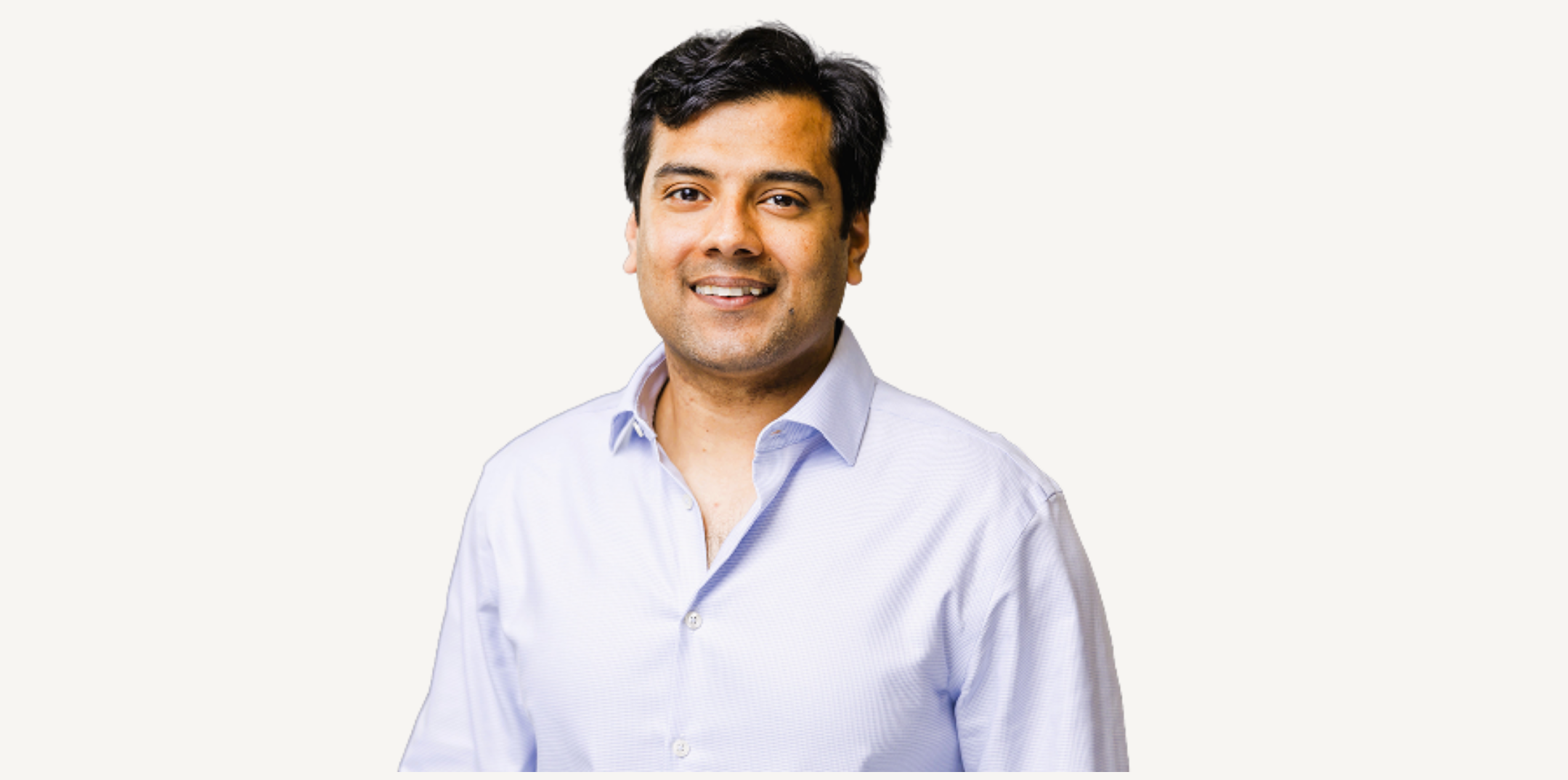
Trener Robotics (San Francisco) announced on February 10 that it raised a $32 million Series A round of funding, bringing the company’s total funding to $38 million. The funding will be used to support training Trener Robotics’ platform Acteris with new CNC tending knowledge, distribution expansion into new markets, and hiring talent to address rapidly scaling demand.
Dr. Asad Tirmizi is the CEO of Trener Robotics, and Fifth Wave Manufacturing welcomed an opportunity to interview him and cover such topics as how the robot training is progressing, Trener Robotics’ methodology with AI, and how the company will roll the product out to the market. We also talked about the importance of partnerships in today’s world when providing solutions to manufacturing. Finally, we cover topics like establishing the company’s beachhead in AI’s use in manufacturing, how their approach is different from competitors, and where Tirmizi expects to be in the coming months.
Fifth Wave Manufacturing: We are lucky to have a very interesting guest with us. And before we reveal who that is, this interview involves the Founder and CEO of a company newly named Trener Robotics. Correct? Is “trainer” the right pronunciation?
Asad Tirmizi: It is.
FWM: Great. The idea behind it is to have robots with industrial skills, and that will start with CNC machining, right?
AT: That is correct.
FWM: Dr. Asad Tirmizi, there are a lot of very good things behind your decision making. I know the hard work that you’ve done leading up to the Series A funding round.
AT: Thank you very much, Dave. It’s a pleasure to be here.
FWM: Tell us about the Series A experience briefly and what you’re doing with the income from that.
AT: Right. The Series A came together quickly and nicely. There were two main reasons for going into the Series A. When we raised our seed round, there was a big question about AI models with no pre-programmed motion. We are talking about precise industries. When you think about robots and CNCs, you are thinking about precision and speed. That’s not what you associate with artificial intelligence. But if you look at the background of myself, my co-founder (Dr. Lars Tingelstad, CTO) and the entire team that we’ve put together, we have been working and researching for the last 15 years on this amalgamation. Can artificial intelligence become precise enough, fast enough, and safe enough for industrial manufacturing? Because this, in my opinion, is the beachhead for AI to come into the physical world. So during our seed stage, I’m very thankful to the early investors and early customers because yes, it was a great demo, but there was always a question mark: what happens when it goes into the real production flow?
The moment we put it onto the production floor it was just clear as a day that we had something revolutionary and it will impact production systems, automation systems and beyond. Then the influx of demand came from our customers, partners and system integrators. In our seed round, we addressed the idea that we did not have enough to cater to all of them. And that is where Engine Ventures (Cambridge, MA) from MIT came forward and they basically put the round together; they led the round. Then we were able to get IAG Capital Partners (Charleston, SC), they have a big footprint in manufacturing. These two companies became the leads.
I stopped the round, or rather, split the round into two. One part has financial investors who are believers in this technology, the other has strategic partners who know that they have important pieces of this puzzle to offer; this is a big puzzle we are putting together, and we are starting with the first few blocks.
It was very important that we get the right strategic partners. The check size doesn’t matter; it’s more about them fitting into the bigger picture. As you may know, vision systems play a huge role in it. Nikon (US headquarters, Melville, NY) came in and then Simulated Systems (Tulsa, OK) for visualization and the for the data that we use to train these models we got Cadence Design Systems (San Jose, CA). That made a very powerful consortium. And now we are very happy that we have the Series A, we have this money, and we have a very clear roadmap of what lies ahead.
FWM: I think the market is very receptive to what you’re doing, and it strikes me that you were on this route a long time before it became de rigueur to be on such a route.
AT: That is correct.
FWM: You’re the right man at the right time for the right job.
AT: Thank you so much, Dave. I really appreciate the trust. My team will be working very hard to use this trust to bring something technology-wise to the industry, which really takes us all forward.
FWM: Also, I want to compliment you in your choice to go after machine tending. Lots of other companies wanted to do strictly palletizing, which is of course a very important area. But in the meantime, an entire swath of manufacturing, the real core of manufacturing, is the pursuit of improvement in areas like machine tending and movement of parts within an organization. I’m guessing that you saw the lack of real serious commitment in that area…well, let’s leave the statement right there and let you respond to that.
AT: You’re absolutely right about that. If you are a startup in the robotics space, you have some applications that I call low hanging fruit. They are already done very well by the robots, and the challenge is limited there. It’s important to understand the challenge that I’m talking about. The challenge is the real world, because real world throws surprises at robots every day. If your robot only repeats certain programmed motions, there are only so many IF THEN ELSE statements that you can put in to handle those surprises. For us, the quest has always been this: robots should do more, robots need to do more because of how the population is aging. In general, technology should come to a point where dull, dirty and dangerous jobs are a choice and not a compulsion. There must be dignity of labor for everyone. This was the guiding principle.
Our technology allows us to do palletizing or pick and place applications, but we knew that applications like machine tending, machining surface treatments, assembly, these are the applications where robots are expected to perform. So much so that even though machine tending systems today do a small percentage of what our software can do, it’s one of the biggest segments for robotics because the problem is so huge. This was just an ideal beachhead for us to train our first skill, where essentially what we do is that the AI model learns everything there is about machining—the visuals of machining, the language of machining, the haptics of machining, and the actions required for machining.
I’m not talking about placing a part or picking it. I’m talking about if the part is smothered in machine oil, the robot should be able to detect that and should be able to adjust its behavior on the fly. If a dangerous situation arises where a part is not properly put into the chuck and you hear something going wrong, the robot must be able to take evasive action. The opportunity here was so huge that it was just a very natural fit. It has served us very well because now we have deployed these systems in over 15 countries. There is an international demand for it, and there is a huge local demand for it.
We look at it like this: we are in the business of training these skill models. We have trained this for machining, and now it’s time for us to train more models.
A very interesting fact that I would like to give you is that we are not machinists. We essentially collected data from humans, from robots, and from teleoperation on how machining is done. We put it into the model, we brought it to the market, and this is the most fascinating thing. Last year there was this machine tool innovation award, and there were machining experts over there. And then our model on a robot won the machine tool innovation award. We had this internal joke that our model is the best innovation this year in machining when we even don’t know the basics of machining. So I think like that was really a fascinating story.
FWM: You’re looking at it from the perspective that there are many, many transactions, but you don’t really have to know about machining. But you’re saying, okay, at some point they have to grab something. At some point they’re work holding. At some point they’re controlling a machine and, and, and boil those down into what AI would say are lemmas, right? These tell you what to do, like a symphony written with so many notes. But you have so many notes in your plans, in your education of these robots, right?
AT: Yes, absolutely. Until now, if you are operating a machine shop, all the domain knowledge is in the head of machinists, all the skill is in the hands of the machinist. At the very basis of it, there is this issue that when machinists retire, they take with them the skills of a whole generation. With this technology, the skill lies in the robot brain. You need very little skill in the human to be able to operate these machines safely, to operate them with a very high productivity rate, and more importantly, to be able to do machining without putting the machinist in a dangerous or tiring situation. The machinist can now work from home and manage their robots. So I think there are many fascinating aspects about this technology.
FWM: That’s really an interesting model that could evolve.
AT: I would say one of the proudest moments in this journey for me was in a deployment. I was just looking at the reaction of the machinists because they always thought that the robot was there to replace their jobs. But when we deployed and when we showed that this robot is your coworker or partner to offload all the laborious, dangerous part of your job, but is completely under your control and dependent on your commands–that you can just sit and give commands in your own language, they were so fascinated.
One of the comments that I thought was very fascinating was this: “Now we can like sit at a desk and do machining, and work from home.” Work from home? People with jobs like mine, when COVID hit, worked from home. It is easy to think that it is applicable to everyone, but it’s not applicable to blue collar jobs. Now imagine this: people in blue collar jobs can also have a schedule, have a normal life where the labor part is done by a machine, and they happen to have a technology which can bring the best of their skills to that machine. I think it’s a sea change in how manufacturing is done, and this needs to spread. AI should not be only for white collar jobs. AI is mainly to empower blue collar jobs, which are the backbone of our economy.
FWM: Well, it is probably no surprise that you have pursued partnerships with some of the leading cobot vendors. You’re enhancing the safety from a hardware point of view too, as well as the AI portion of it, if I understand this correctly.
AT: If you look at the robot, the robot controller and the expectations we have of the robots for the past 50 or 60 years, the impact of the robots on humans have been limited, while the potential impact is huge. It was natural that when we made this technology and brought it into the market, there was an interest from the OEMs. And we are very proud to partner with some of the best in the business. And the reality is that we need a very close partnership. The OEMs improve the quality of the hardware, the capabilities of the hardware, and then companies like us improve the artificial intelligence layer on top of this hardware. And I think this combination will be very good for humanity.
FWM: Interesting also that you really haven’t pursued the humanoid robot model. And my thought is I don’t know if humans are the best model to copy. When it comes to getting work done, why do we have these four limbs? Why do we stand between five and six feet tall? Why any of this? And, and it takes design time, constant balance checks to create practical things like us, and it seems to me a waste of resources. It makes me agree with your strategy of going after the robot arm for things like machine tending.
AT: There are two things that I want to say. As humans, we have a fascination with the human body form. Growing up, we all learned about how special we are. It’s only when you grow up and dive a little deeper, we find out that in the largest scheme of things and even in the animal world, we aren’t that special! We got the intelligence, but there is nothing special about the human body form. However, it is true that since we are the apex predator, we have formed or we operate in a world that is made for our body form.
However, being a roboticist, it’s very clear that there is a law of degrees of freedom at play. For instance, you still see SCARA robots in the industry. Why? Because it’s three degrees of freedom. They are fast, and you don’t need six degrees of freedom arms to do the kinds of tasks they do. For a task that can be done with three or six degrees of freedom with a robot that probably costs five, $6,000 to $25,000, if you want to replace that with a humanoid, it costs many thousands of dollars. And above it all is 58 degrees of freedom out of which 50 degrees are just trying to balance you. I get a little skeptical. However, as a roboticist I wish those people that are working in this field all the very best, because they have gotten a lot of attention and capital into robotic research.
My strategy was always this: I don’t want to form a company that is dependent on venture dollars to survive. I wanted our impact to be felt from day one. I was very realistic about the market’s location and maturity, and the impact, and the sooner we can reach impact, then as a software, we are agnostic to the embodiment. We can work on a robot with six degrees of freedom. We can work on a mobile robot, we can work on a humanoid, but let’s be realistic, there is absolutely a zero market for humanoids on which we can deploy right now. For mobile robots, it’s increasing. But in industrial domains, it’s still very much a work in progress.
With fixed arm robots, it’s a very different ballgame. Number one, we have millions of these deployed as a base, thousands of companies that have decades of experience deploying robots, and then a full system integrator network available anywhere in the world. And every prediction and my own thought process suggests, no matter how many humanoids or mobile robots come in, there will always be a spot for fixed robotic arms that are highly specialized to do a family of tasks. For us, it was just the natural beachhead market. We are very happy about this decision because it has been a very impactful decision.
FWM: The ability to process regular language commands and make that into code to me means autonomy. It seems like that would translate well to the model of a robot arm on a mobile platform, but it also has some machine vision (or for another Scandinavian reference here, Sonair in Finland has sensing that’s ultrasound) and there is just so much happening at all the different places of robots. I could see where an autonomous robot that’s not humanoid would be adopted faster, and it would come to pass with your software where you could treat that robot like a colleague, in a way.
AT: Correct. We approach the problem with the thought that it should be intuitive to control the robot. The robot should have a knowledge and understanding of its environment, the language, the vision, to be a partner in what we need to do. When I say we, that means the human user and the robot. The language, of course, is a very important tool. That’s our primary tool to communicate between ourselves. Now, we have brought this to the robot, but frankly, there’s a lot more than language that we have to do to make sure that these intuitive simplistic commands result into robust industrial grade solutions. It’s not like you just say something and the robot start doing something that is a very well developed, well thought out framework where language, vision, touch, and the knowledge base of the robots support the human so that even if they have partial knowledge or partial command of the language, they are able to give out a precise let’s say automation to, to basically go ahead with the application.
FWM: It gets complex very quickly, and the meaning of a word becomes an atom, almost, and a sentence becomes a molecule. We’re not there yet, but I think we will be because all kinds of strides are being made in those areas too. Are you working with semantics people?
AT: Our background in this technology goes back many years. We knew then that we must go from what is called functional programming or procedural programming to something called declarative programming. Even back in 2016 and 2017, my co-founder and I we were working on these declarative paradigms. These were domain-specific languages that can be used to tell robots what needs to be done. There is a whole layer of how you get partial information from the human. Then you combine that with your semantic ontological visual and spatial understanding of what is going on around you. You query the user if there is any confusion in this knowledge graph that you are making.
It’s a fascinating field because for example, without our framework, let’s say the robot has to put a sock on and then a shoe on. You know the fact that you cannot put a shoe on before a sock. Now this is a complicated problem to tell the robot, because you can absolutely put the shoe on first, and in a way, you can put a sock over a shoe as well.
But what is the ontological connection between these two entities and storing this? If you see a logical issue communicating it and with the human, is that really what you want or is this a logical error? I think it’s fascinating to see how this works in the product, because we often deal with complicated, connecting, logical decisions. It’s so easy to get something mixed up, especially in production, and the consequences can be horrendous. I think this is a valuable layer that our software adds to production environments as well.
FWM: Oh, the decision trees and the logic trees are mighty and large.
AT: And wow, what we find fascinating is just like the sock and shoe, maybe a very exaggerated example, but in machining, machine tending, the type of tool and the type of job can change everything. And when you have a coworker who would not make mistakes in these logical connections and can communicate to you about it, one of our biggest value proposition is how much the human error comes down. Because there is a robot that is supporting you in setting jobs and then doing jobs.
FWM: Yes. One of the problems, sometimes, is doing exactly what the person told you to do!
AT: <Laugh>.
FWM: You have to have the framework of it in mind as you’re creating the, the commands for the job.
AT: Absolutely!
FWM: Asad, that is all the questions I had, but if you’d like to add anything, please feel welcome to do so.
AT: It has been fascinating talking to you. I think the only thing that I would like to say is this: In the next five to 10 years, every robot that is currently being manually programmed, we believe it will be moving towards these very powerful AI models that will be a coworker to the end user. I feel like it’s a very powerful technology that we have where we can take data about how a certain industrial task is done, convert it into a robust model that then goes onto these robots, and makes them into these intelligent all-knowing creations that are working for you. With our partners, we now have a roadmap of many more skills that will come. So we will be making assembly skills, stacking skills, machining surface treatment.
Our first target are jobs that are very hard to do—industrial jobs where dignity of labor is compromised almost, when you’re doing the job. But as we go forward, we expect this to continue to many service jobs and jobs where we don’t think that robots today can come in and help us. It’s an ecosystem that we have to create because it’s such a huge market.
We look forward to working with OEMs, and system integrators are a huge part of our go-to market. It’s often like when you create something special, some companies say, now you can skip the system integrators. I’m completely in the other camp. I basically feel empowering system integrators is the most important thing a tech company can do because there they have knowledge that is built over generations and somebody has to take care of these physical systems. So we have created a work plan, which is a win-win for OEMs, end users and system integrators. We will roll out that plan, and we are looking forward to working with the entire ecosystem.
FWM: Yes. Those are the people on the street. They’re the ones going up and down the aisles in the shops. I can envision, as you probably can, the way you walk into a machining establishment of any size, and you have an aisle with 20 or 30 machining centers, and I could see 20 or 30 robots at those machines.
AT: Absolutely. I think like we’ve started something that will have a huge impact and this capital, this attention that we are getting, this will only accelerate this process. We are very motivated to move extremely fast. And if something can be done in six months, I want it to get done in six weeks and empower the ecosystem as fast as we can. I’m really looking forward to doing that.
FWM: I have to say you have been one of the most interesting interviews and people that I’ve met along the way in this six-year journey I’ve had. Let’s touch base once in a while, maybe do another interview for an update and see where you are in the plan. You and I seem to be on a similar wavelength too.
AT: Thank you so much, Dave. I really enjoyed this conversation and I absolutely agree. I think the next episode should be with one of our customers or add one of our real deployments, you know, because I often say I don’t like to do the talking. I like the robot to do the talking <laugh>, because literally our robots, they talk. And I think yes, I would be very honored if you can be a partner and a follower of our journey. And I think there are a lot of good things that can come out of this projection that we can get from your work.
FWM: That’d be fantastic. And thank you for today.
AT: Thank you so much, Dave.
More information: trener.ai